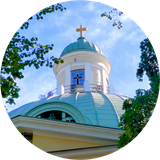
on the 180th Anniversary of the Holy Church of the Holy Martyr Empress Alexandra in Turku
Blessed children of the Parish of Turku,
The spot on the northern side of the central square, where for one hundred and eighty years your church has stood, had initially been intended for the town hall. Carl Ludvig Engel, who after the fire of 1827 undertook to redesign the city, ultimately proposed that this location be given to an Orthodox church, for soldiers, civil servants and merchants who had come after the war of 1808–1809, when Finland passed under Russian rule, many of them transients. A proposal for an Orthodox church had already been made in 1814. It remained on paper.
The order of Nicholas I was required, in January 1838, for the work to proceed, and the consecration was celebrated on 2 September 1846. The patron saint, Saint Alexandra, who was martyred in 303, was preferred probably because the empress bore the same name. Irrelevant now if courtly politeness counted in the choice; the church was dedicated to an empress who, according to tradition, did not consider the palace when the time came for confession.
For a long time the church remained foreign to the city that hosted it. Foreign the language of the services, foreign the customs, and the building, however beautiful it was, many saw it as a symbol of an authority they had not chosen. After the independence of Finland there remained a few hundred Orthodox. Several had passed into the Lutheran Church and had made their surnames Finnish, something we shall not judge strictly, if one considers what a Russian name meant then in a country that had just stood on its feet.
The history of a monument could have closed there. In 1923 however the Ecumenical Throne received the Orthodox Church of Finland under its care and granted it autonomous status. We had the blessing to celebrate together the centennial of this important anniversary already three years ago.
This autonomy, because it is often misunderstood, is worth stating in simple words. The Church of Finland itself elects its bishops, worships God in the language of the place and stands within Finnish society as the local Orthodox Church, canonically bound at the same time to the Mother Church of Constantinople, with a bond that Our Modesty experiences first of all as a relationship of love and common responsibility. Finland showed, and for the Orthodoxy of the twentieth century it was not, we would say, at all self-evident, that a Church with roots in Karelia and in the tradition of Valaam – from there originate also many of the large icons of your church – can become genuinely local without being identified with a nation. Ethnophyletism had been condemned by the Great Synod of Constantinople in 1872. We do not claim that the road has been smooth; it would be ahistorical to erase the tensions and the bitternesses from a festal text.
On the glass of the honoured icon of Saint Alexandra there is preserved a design which was not engraved by human hand. It was left by the shockwave when, in the Winter War, the centre of the city was bombed: a long line, a triangle, a circle. The faithful read there human life, the Holy Trinity, eternity. Perhaps the historian will smile. We remember in what time this reading was made, a time that brought to Turku the refugees of Karelia and raised the parish to over two thousand souls. They found the church ruined. The parish priest Leonidas Homanen began a collection; the city – let us note it with gratitude – also helped, the same city that a century earlier saw in this dome a sign of foreign power, and in 1960, repaired; the church was reconsecrated.
We have dwelt somewhat extensively on the past, because Turku condenses, in the size of a parish, much of what occupies the Orthodox Church in Europe today. For this reason, our Modesty wished to be present with a Patriarchal Exarchy, headed by His Eminence Metropolitan Emmanuel of Chalcedon, who conveys this word to you and will converse up close with His Eminence Archbishop Elias of Helsinki and All Finland and his fellow Hierarchs concerning matters that are not regulated by correspondence. The war on European soil not distant from Finland has wounded also the unity of the Orthodox, and in certain cases communion in the same Chalice has been severed. When and how this wound will be healed, we do not know.
There is also something less noisy. In your parish, which spreads as far as Rauma, Salo and Åland, the Sunday Liturgies are now celebrated in more than one language, because the people who stand before the iconostasis have come from many countries, as once the soldiers and the merchants, as later the Karelians. Here, we think, Finland has something to say to all of us, since the question of the nineteenth century returns with other terms: how does a Church remain open to the foreigner without itself becoming foreign again within its place?
And our witness to other Christians. In your country the Orthodox live as a small minority beside the Lutheran Church, and common witness begins there from good neighbourliness. Last year marked one thousand seven hundred years since the Council of Nicaea; its Symbol we confess together with many who do not belong to the Orthodox Church, and this is not a little thing in a world that hardly listens anymore to Christians when they speak separately.
We are informed that the church is preparing for works on its foundations and that the parish will gather for a period in a temporary space. We shall not make an allegory of this. A building of brick with a wooden dome, after one hundred and eighty Finnish winters, wants its care, and you do well to give it in good time.
With these thoughts we pray together with you and we invoke upon our brother and concelebrant in the Lord’s mysteries Archbishop Elias, upon the member Hierarchs of the Holy Synod, upon clergy and people, upon every person who crosses the threshold of Saint Alexandra, whether to light a candle or only to see the work of Engel, the grace and the infinite mercy of God, through the intercessions of the Holy Martyr.
† Bartholomew of Constantinople